
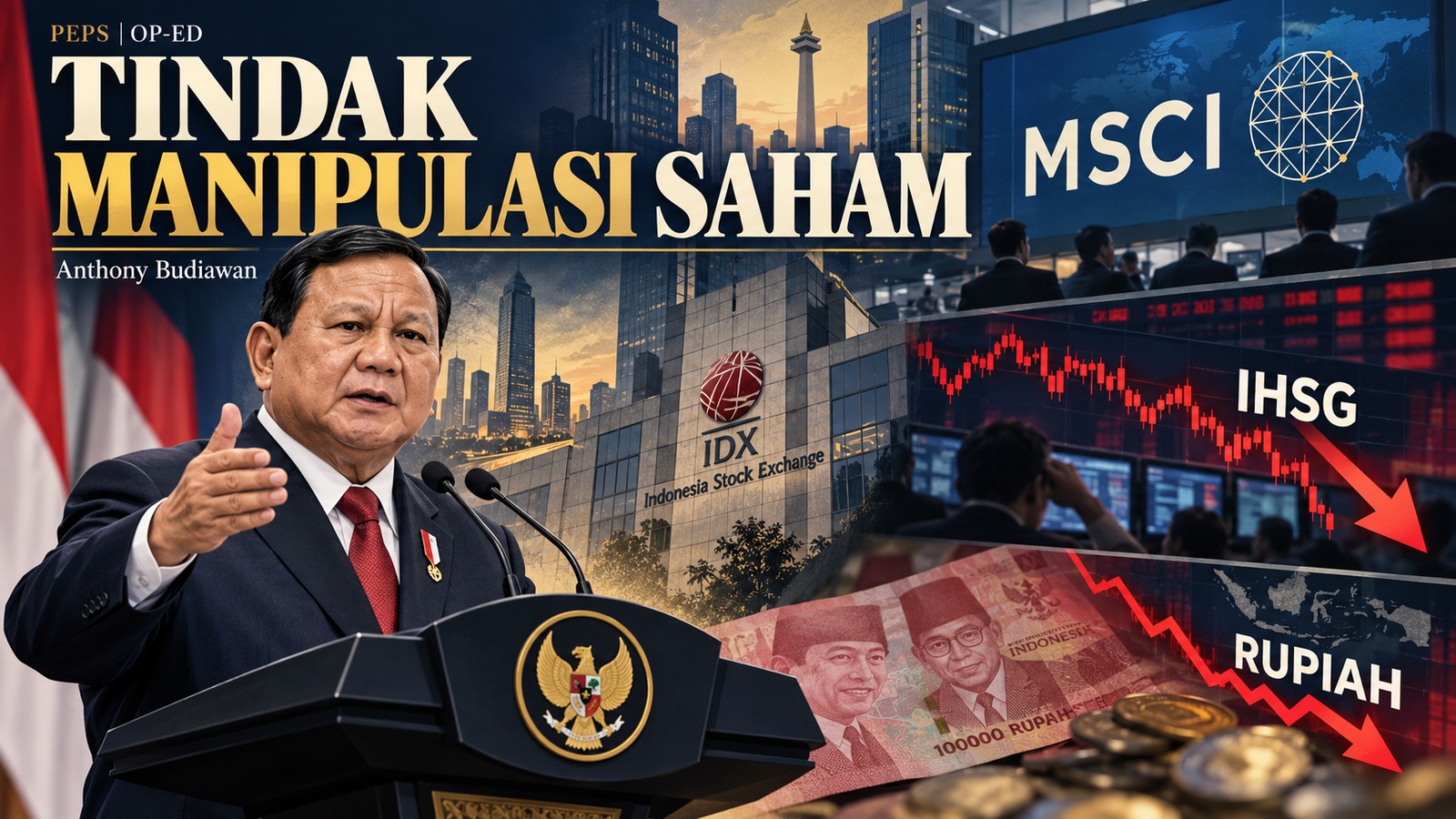
The President accused MSCI of trying to intimidate Indonesia. At the plenary cabinet meeting on October 21, 2026, he said, “We keep being threatened,” and declared that the Indonesian nation feared no one and would not be cowed. Courage does not answer MSCI's questions. There is no threat here. There is an assessment of stock-market governance, and that assessment is correct.
MSCI's concerns focus on the governance of Indonesia's stock market. Its assessment addresses opaque share ownership, concentrated holdings, and suspected coordinated trading that has gone unpunished. A warning had already come in January 2026, and the IDX president director resigned on January 30. Almost nine months passed without evidence of improvement. On October 15, 2026, MSCI opened a consultation on downgrading Indonesia to Standalone Market status, two categories below its current classification, alongside Zimbabwe, Nigeria, Lebanon, and Ukraine. No Asia-Pacific country is in that group. Indonesia would be the first.
The cost is already visible. The Jakarta Composite Index plunged 11.6 percent on Friday, October 16, 2026, and touched 4,911 on the next trading day, Monday, October 19, its lowest level in ten years outside the pandemic period. UBS estimates outflows of up to US$19 billion. If selling spreads to government debt securities and Bank Indonesia instruments, outflows could reach US$20–25 billion, and the rupiah could fall to Rp20,000–Rp22,000 per US dollar. External debt equivalent to 3.13 times foreign-exchange reserves and a current-account deficit of 3.3 percent of GDP in the second quarter of 2026 increase that vulnerability.
The response that “economic fundamentals are strong” misses the issue. Fundamentals mean nothing to investors when share prices can be manipulated and the perpetrators remain untouched.
MSCI's findings are not new. On January 12, 2022, I wrote that OJK supervision had failed to detect share-price manipulation from initial offerings through the secondary market, year after year, through manipulated stocks. The victims shifted from retail investors to institutions managing public funds: the Pertamina Pension Fund lost approximately Rp600 billion, Jiwasraya Rp16.8 trillion, ASABRI Rp22.78 trillion, and Bumiputera and Minna Padi more than Rp4 trillion each.
The same stocks recurred across portfolios, including MYRX at Pertamina and ASABRI. MYRX is the ticker for PT Hanson International Tbk, a property issuer owned by Benny Tjokrosaputro. ASABRI bought approximately 6 percent of its shares in January 2016, during the same period in which Benny sold part of his stake. Several stocks in ASABRI's portfolio were also held by Jiwasraya and Minna Padi: ARMY, IIKP, MYRX, PCAR, SMRU, TRAM, and BTEK. BTEK reached the floor price of Rp50 per share at the end of December 2019, while trading in the other six had been suspended by January 2022. Hanson was declared bankrupt in 2020, and Benny became a defendant in the Jiwasraya and ASABRI cases. BPK identified manipulated stocks at Jiwasraya in its 2016 examination, but the case only became public when policy payments defaulted in 2018.
The pattern is the same every time: supervision does not act until losses mount. Perpetrators understand that the probability of getting caught is low while the gains are large. Manipulation is a rational strategy.
That pattern recurred in 2026. On October 16, 2026, the day after MSCI's announcement, OJK announced the largest fines in Indonesia's capital-market history: Rp2.1 trillion, approximately US$117 million. Rp1.5 trillion concerned manipulation in the trading of DSSA shares (Dian Swastatika Sentosa, Sinar Mas Group). Rp500 billion and Rp100 billion concerned the public offerings of BREN (Barito Renewables Energy) and CUAN (Petrindo Jaya Kreasi), issuers associated with Prajogo Pangestu: IPO shares had been allocated from the outset to parties connected with controlling shareholders, with subscribers' identities obscured. The fines were imposed on the parties involved, rather than the issuers.
These are administrative sanctions. For perpetrators who obtain unlawful gains, fines are merely a cost. Findings of criminal offenses must not end with administrative fines.
IDX sought clarification from MSCI. That is the wrong direction. MSCI has explained its reasons clearly. OJK and IDX owe the explanation: why was suspected coordinated trading allowed to continue for years?
The time remaining until the April 30, 2027 consultation deadline is only enough for action, rather than new regulations. MSCI's decision will be announced by June 30, 2027. Disclose the ultimate beneficial owners of all issuers, including in the acquisition of Bayan Resources shares, and examine relationships between shareholders when calculating free float. Prosecute share-price manipulation and coordinated trading as criminal offenses, including older cases. Build an early-warning system and investigate officials who allowed these practices to continue.
In Davos, the President pledged to uphold the law to secure investor confidence. MSCI is simply holding him to that pledge.