
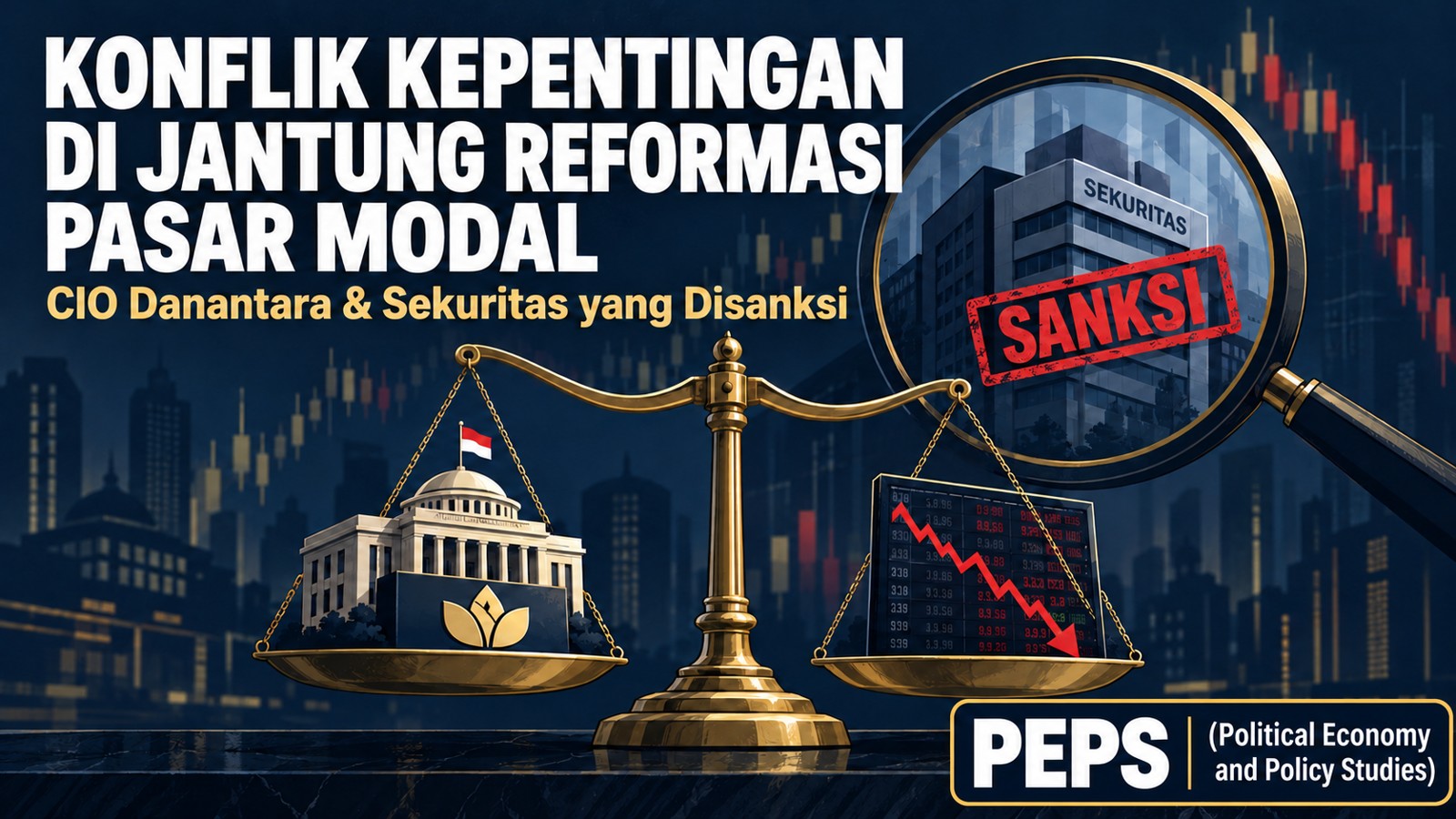
Bloomberg reported that Pandu Sjahrir, Danantara’s Chief Investment Officer, indirectly owns 27.5 percent of PT Supra Sekuritas Indonesia through PT Asha Artha Sehati, almost all of whose shares are owned by Pandu. The stake was acquired in late 2023. Bloomberg’s sources identified Supra as the firm referred to by the initials SS in OJK’s announcement of sanctions concerning trading in DSSA shares.
Pandu’s spokesperson confirmed the ownership and described it as a passive investment. According to the spokesperson, Pandu has never served as a director, commissioner, or manager of Supra and has not been involved in its operations, trading, or compliance decisions.
Passive status does not eliminate the economic interest of a 27.5 percent shareholder. The explanation about operational involvement also fails to answer the central question: how that business interest is separated from Pandu’s authority at Danantara.
As CIO, Pandu carries out a mandate to manage state investments, engages with global fund managers, and discusses capital-market reform. At the same time, he holds a personal investment in a securities brokerage. Danantara’s decisions on broker selection and investment placement must be examined.
Pandu met MSCI CEO Henry Fernandez to discuss improvements to Indonesia’s capital market. The transparency he supports also applies to his ownership in Supra.
In my October 24 article, “MSCI Is Not Threatening Indonesia, It Is Seeking to Protect Investors,” I highlighted opaque share ownership, ownership concentration, and weak enforcement against coordinated trading. The Supra report adds another issue: who owns the securities firms intermediating transactions, and how are they connected to those making state investment decisions?
OJK’s October 21 press release stated that clients manipulated DSSA share trading through several exchange members in a planned and structured manner. OJK imposed administrative fines on nine exchange members. One SS director had their professional licence suspended for one year.
In the BREN and CUAN public offerings, OJK found that the identities of subscribers connected to the companies’ controlling shareholders had been obscured. The practice concentrated shares within certain groups and limited shares circulating in the market. The principal fines in the three cases totalled Rp2.1 trillion.
Administrative sanctions do not settle criminal responsibility. OJK must trace who arranged the transactions, issued instructions, concealed subscribers’ identities, supplied the funds, and received the gains. Client identities, account beneficial owners, funding sources, and relationships between accounts are recorded in transaction records that OJK can trace. The examination must go beyond the brokers’ names.
OJK still uses initials in its sanctions announcements. As a result, the public relies on media investigations to learn who was sanctioned. OJK must disclose the parties’ names, violations, grounds for sanctions, objection status, and criminal follow-up to findings of market manipulation.
In my October 16 article, “Stock Index Plunges: MSCI’s Warning Vindicated,” I demanded an examination of the failure to act against coordinated trading. That examination now extends to the management of business interests held by officials with authority over state investments.
Danantara must disclose when Pandu’s ownership was reported, who received the disclosure, and what restrictions on his authority were imposed. Danantara must also disclose whether it or entities under its management have ever used Supra as a transaction intermediary. If so, disclose the basis for selecting the broker, the officials who approved it, and Pandu’s involvement in that decision.
During the examination, Pandu must be excluded from all decisions involving Supra and transactions connected to his investment interests. Ownership disclosure alone is insufficient if the official concerned continues to decide transactions affecting his business.
Danantara must release Pandu’s ownership disclosure and examine the related investment decisions. OJK must disclose the identities of those sanctioned and take findings of market manipulation into criminal proceedings. The government, Danantara, and OJK must publish the results: whether authority over state investments has been separated from officials’ private interests, and whether market manipulators are criminally punished.
—- 000 —-